


Introduction
The 2025 Annual Impact Report marks a definitive shift in the mission to bridge the gap between education and employment, a challenge viewed as a shared responsibility across the entire ecosystem.
Today’s learners see post-secondary education as a critical pathway to professional attainment, with 84% of applicants choosing institutions based on their potential for career preparation. However, the traditional reliance on late-stage, high-stakes internships has created a systemic bottleneck that often excludes the very populations that need the most support.
To solve this, Riipen is re-imagining the transition to the workforce as a sustained dialogue of frequent, accessible professional interactions that build vocational identity incrementally.
This was not just a year of growth. It was a year of building a better model.
Evidence-based innovation
The continuum represents a deliberate shift from isolated internships to a sustained, multi-stage architecture of career development. This approach prioritizes the principles of dosage and scaffolding, moving beyond traditional models to ensures that every learner accesses the right opportunity at the precise moment their goals and skills evolve.
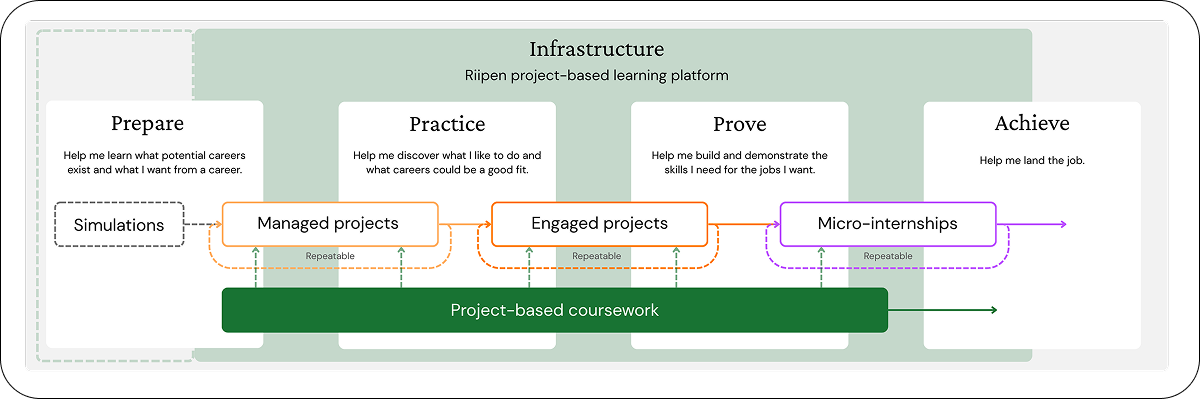
Managed Projects
In late 2025, we developed Riipen Labs to demonstrate this managed architecture, with an initial pilot launched in January 2026. The pilot engaged over 1,500 students in five-person teams to tackle growth challenges for Canadian small and medium-sized enterprises. This team-based approach fostered a collaborative environment in which students could emulate a professional agency structure while solving authentic organizational problems. Data revealed a significant increase in learners' ability to take initiative and move stalled projects forward, with 98% of participants stating they would recommend the program to peers early in their career journeys.
Engaged Projects
Launched in 2021, the Level UP program remains a leading example of our earn-and-learn model. By connecting post-secondary students with small businesses for 60-hour-long short-term projects, the initiative drives significant dual impact. 80% of learners gain career clarity and 85% secure a professional reference through their project work, all while earning a $1,400 stipend upon successful project completion. Most importantly, 76% of a representative sample of participants report receiving job offers after program completion.
Micro-Internships
Launched in May 2025, the Riipen FuturePath program ushered in a new chapter of employer co-investment. Unlike fully subsidized models, participating organizations contribute 50% of the learner stipends. The result is a powerful signal of co-accountability: employers putting real capital behind the talent pipeline while helping scale meaningful, project-based opportunities for learners across Canada. By the end of 2025, employers, the majority of whom engaged with FuturePath as their first Riipen program, contributed over $1 million towards learner stipends. 87% of participating employers reported increased operational efficiency, and 95% were satisfied with the program.
2025 at a glance
Work-integrated
Learners increasingly define the excellence of post-secondary education through the lens of career outcomes. Work-based learning serves as the critical intervention that aligns academic theory with professional practice.
Transformed departmental tasks into paid, skill-aligned projects, creating a centralized marketplace for economic mobility. The impact was immediate: 73% of students reported measurable improvements in their communication skills, while 82.3% felt a newfound confidence in applying their academic knowledge to real-life work.
Focused on bridging the gap between local talent and Calgary’s economic future. By facilitating capstone projects that serve as professional gateways, TalentED YYC helped 77% of participating learners feel better prepared for the workforce.
Balanced central strategic leadership with faculty independence, ensuring experiential learning wasn't just a "bolt-on" but a core academic pillar. This intentional design led to a 22% increase in students’ understanding of the concrete steps needed for career preparation.
2025 marked a five-year peak in engagement. According to a nonprofit employer working with LMU learners, their co-delivery model has become a "very powerful tool" for nonprofit and industry leaders to access "amazing talent," proving that when roots run deep, the resulting ecosystem benefits the community as much as the student.
REACH UP this year reached a staggering milestone, funding over 50,000 student experiences across Canada. This level of sustained investment has allowed us to create durable pathways that connect learners to the workforce at an unprecedented scale.
We are architecting equitable internship pathways for 11,000 students across 25 member institutions. By focusing on independent colleges, we ensure that the competitive advantages of project-based learning are accessible to students regardless of the size or geographic location of their home institution.
Through the U.S. Chamber of Commerce Foundation’s EPIC initiative, we have expanded regional activation (now working with 20 Clearinghouses) and credentialed career challenges that align student talent with real-time employer needs across the United States.
This multi-year initiative, funded by Axim Collaborative (the MIT-Harvard nonprofit) and run by Complete College America, is designed to democratize AI education across open-access institutions. Focused on five key community colleges the program embeds AI-focused projects directly into college curriculum.
As of late 2025, the program saw 1,205 sign-ups and 3,190 cumulative learning hours, with participants reporting significant gains in both technical and durable skills.
By designing an innovative bursary program to dismantle the financial obstacles facing underrepresented talent, we empowered a new generation of professionals, with 79% of participating learners reporting a measurable increase in their critical thinking skills.
Co-designed to preserve the university's signature asynchronous, competency-based model while delivering rigorous industry practice. 76% of learners felt the experience made them significantly more marketable. 71% of participating employers reported that the partnership increased their team's capacity to focus on other high-value projects.
Architected a unique peer-to-peer "internal matching" ecosystem through the Business Bootstrap and Research to Venture programs. This model connects student entrepreneurs directly with researchers, turning the campus into a self-sustaining engine for innovation.
Testimonials
"When done thoughtfully, experiential learning, especially through platforms like Riipen, can transform the classroom from a passive learning space into a dynamic launchpad for career and personal growth."
"We are excited to work with Riipen to access work experiential learning components in the classroom. We foresee the involvement of Indigenous businesses and bands as a benefit for the students to kick-start their careers."
"I firmly believe that if such a platform didn’t exist, one would have to be created. Université de Hearst emphasizes an experiential approach and promotes education with a strong social impact, and Riipen enables us to achieve those ideals." (Translated from French)


